
Adult Family Homes in Washington
How to get licensed and choose a property
By Pramod Poudel, Washington real estate broker at Real Broker, LLC
[Disclaimer: This blog post is just for an informational purpose only and not an investment advice]
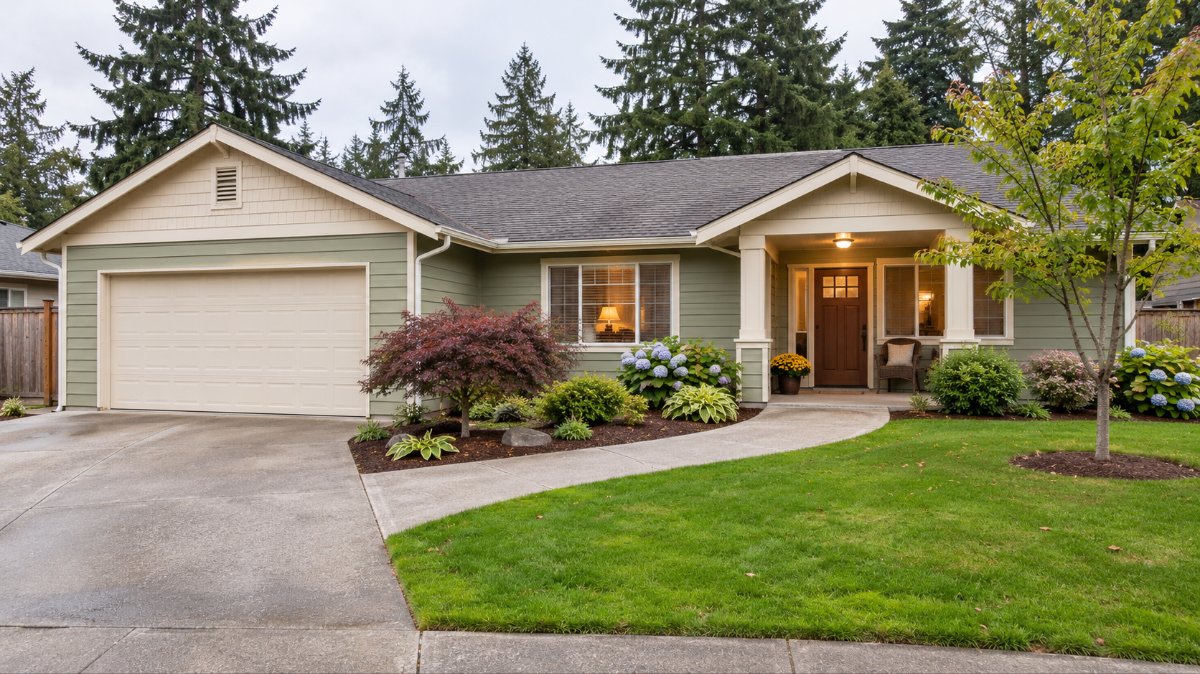
Illustration of a residential property with a step-free approach. Each address needs its own review.
If you want to open an adult family home, start with the operator and the address. The state must approve the provider, and the property has to support the residents you intend to serve. A house with several bedrooms can still be a poor fit if getting from a bedroom to a bathroom or exit requires stairs, or if upgrades cost more than the business can carry.
I’m Pramod Poudel, a Seattle-area real estate broker. I can help you compare properties, ask the right questions before you make an offer, and connect you with qualified specialists for the building, care, financing, and legal decisions.
What an Adult Family Home Provides
An adult family home, or AFH, provides room, meals, and personal or special care in a residential setting. Residents may include older adults and adults with disabilities who need help with daily tasks such as bathing or dressing. A standard AFH can serve two to six unrelated adults within its licensed capacity. A seventh or eighth bed requires separate state approval. You need to check the state definition and the capacity rule.
Why Washington Has a Large AFH Market
A small home appeals to some residents because daily life takes place in a familiar residential setting. Families may look for a location close to them, a home that can meet specific care needs, or a provider that can accommodate a resident’s language and routines. The fit varies from home to home.
Washington already has an established AFH market. The state counted 5,402 Medicaid-contracted AFHs in January 2026, up from 5,287 in October 2025. Roughly two-thirds of the January count was in King, Snohomish, and Pierce counties. Those are contracted homes, so the count does not capture every private-pay home.
|
Area |
Medicaid-contracted homes |
Licensed beds in those homes |
Clients authorized for AFH services |
|
King County |
1,590 |
9,255 |
4,300 |
|
Snohomish County |
1,047 |
6,067 |
2,979 |
|
Pierce County |
941 |
5,496 |
2,798 |
|
Washington |
5,402 |
31,352 |
16,066 |
Source: DSHS January 2026 county snapshot and October 2025 comparison. The January map uses January 9, 2026 facility and bed counts and November 1, 2025 client authorizations. The columns cannot be used to calculate vacancy or occupancy.
The Washington Office of Financial Management forecast projects that the state’s population aged 85 and older will rise from about 131,000 in 2020 to 523,300 in 2050. That points to a growing need for long-term care options. It does not tell you whether a particular home will fill.
How I Would Test Demand Near an Address
Map the actual competition. Use the DSHS Adult Family Home Locator to compare licensed homes by ZIP code and specialty. For a property in Renton, Kent, Bellevue, or the surrounding area, look at the places families and caregivers can reasonably reach from that address. A county total is too broad to price the business.
Find out what local families have trouble finding. Talk with local case managers and discharge planners about the types of placements that are difficult to arrange. Compare available care, payment sources, staffing, and access for family visits. Validate the pattern with several sources before budgeting for admissions.
Match the care model to the home. If you plan to support residents who need assistance with mobility, I’ll use that to narrow the property search. Your care team and the building official can then assess what the proposed layout can support.
Plan around the approved bed count. Expansion to seven or eight beds requires DSHS approval. A home applying to expand generally needs at least 24 months since its initial license, at least 12 months licensed for six residents, and two full inspections without enforcement actions. At that capacity, a residential sprinkler system is required to serve residents who need evacuation assistance. Seven and eight bed requirements
Business Models and Startup Costs
You can convert a house you already own, buy or lease a property for a new AFH, or acquire an operating business. Each choice has a different starting cost. A conversion ties up money while you prepare the home. An acquisition may come with staff and revenue history to evaluate, along with obligations that can affect the sale.
If your plan is to own the property and lease it to a licensed provider, model the property rent separately from the care business. Ask your attorney, lender, and insurer to confirm the intended use and review how the lease allocates repairs, improvements, insurance, and delays. I can help compare the cost of buying versus leasing a particular home and coordinate those reviews.
Private Pay and Medicaid
For private pay, estimate what residents will actually pay for the services and room arrangements you can offer. For Medicaid, the AFH license and Medicaid provider contract are separate. DSHS asks for the home’s license number when you request an AFH Medicaid contract. Use the Office of Rates Management for current schedules and confirm payment for the resident’s assessed needs, applicable rate area, and any resident contribution before using a rate in your budget.
A Six Bed Example
Suppose an operator collects an average of $8,000 per occupied bed per month, budgets $30,000 in fixed monthly cash costs including baseline staffing, debt service, owner pay and reserves, and spends $1,500 per occupied bed in additional costs. These are assumptions to illustrate the math, not local rates or a prediction.
|
Occupied beds |
Monthly receipts |
Cash after modeled costs |
|
4 of 6 |
$32,000 |
−$4,000 |
|
5 of 6 |
$40,000 |
$2,500 |
|
6 of 6 |
$48,000 |
$9,000 |
At four residents, the example loses money. At five, it covers the modeled costs. One vacancy cuts gross monthly receipts by $8,000 even though many expenses continue. Actual staffing costs can jump when a resident needs more care, and the example does not estimate taxes or one-time opening costs.
Build a separate opening budget. Price design, permits, accessibility and fire upgrades, furnishings, training, application fees, and insurance. Set aside cash for rent or debt service and operating costs during permitting, inspection, and the months it takes to fill beds. For annual licensing, DSHS announced a per-bed fee of $450 effective July 1, 2025, or $2,700 a year at six beds under that schedule. Verify the fee in effect when you apply.
When comparing two addresses, I look at the combined cost of the property, required work, and time before opening. A lower asking price can be erased by a difficult conversion.
Screen the Property Before Making an Offer
Washington treats an AFH as a residential use and allows it in residential and commercial zones, including single-family zones. The home still has to meet applicable local building, housing, and fire safety rules. RCW 70.128.140 is the starting point. Approval depends on the address, the layout, and the residents you plan to serve.
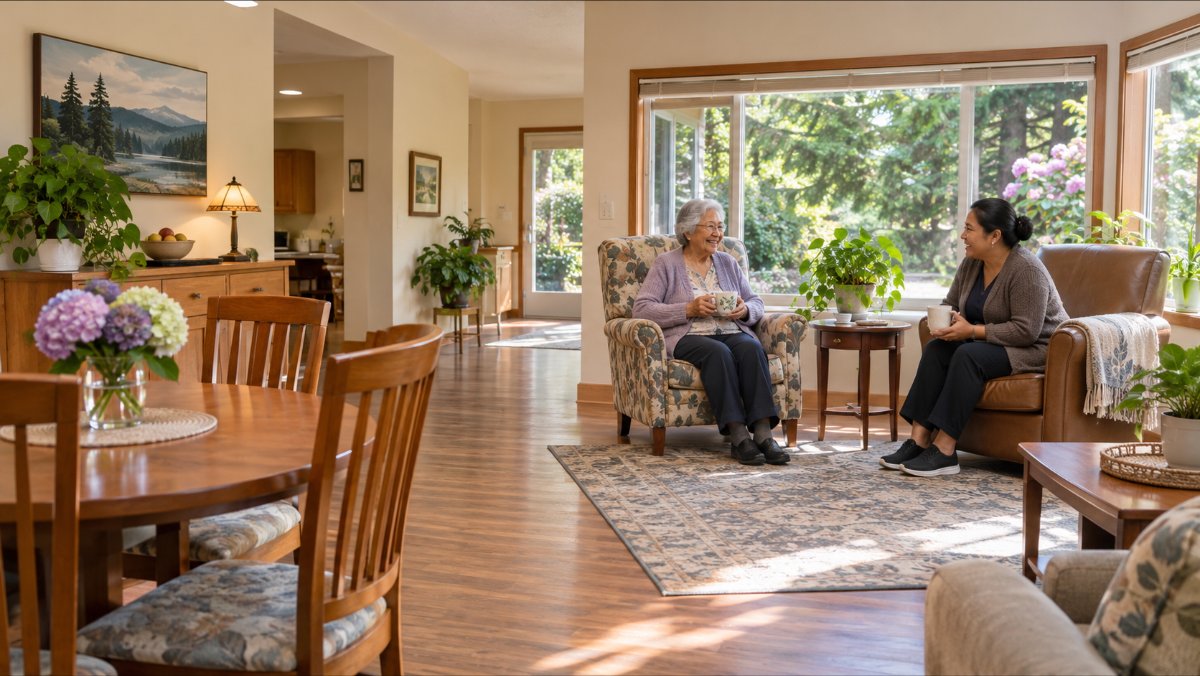
Illustration of a shared living area. The route between bedrooms, bathrooms, and exits matters as much as the room itself.
Identify the permit authority. Confirm the parcel and whether a city or the county handles the permit. I can help find the permit history and connect you with that office. Start with the DSHS local inspection checklist, then check the local process, such as Renton’s AFH permit guidance, Seattle’s AFH page, or King County’s inspection checklist.
Walk the route a resident would use. Check the path from drop-off to entry, bedrooms, toilets, bathing areas, common space, and exits. Bring floor plans and the intended resident evacuation needs to the building official. Ask which rooms can be approved, what door, bathroom, or exit changes are required, and whether fire protection work is needed.
Verify the site and permissions. Check permits for finished basements or additions. If the home uses septic, verify the system’s approved person capacity and proposed AFH use with the local health authority. Have title and legal professionals review recorded restrictions, and get written owner permission if you’re leasing.
Price the work before committing. I can coordinate walkthroughs with the building and design professionals, compare homes using written estimates, and work with your lender and attorney on the review period and closing conditions. Ask about financing and AFH liability coverage early enough to act on the answer.
How to Get an Adult Family Home License
The Washington Department of Social and Health Services (DSHS) licenses AFHs through Residential Care Services (RCS). Begin the operator and property work in parallel. The DSHS prospective provider page is the starting point for the latest forms, links, and checklists.
1. Confirm who will qualify. Identify the provider, entity representative if applicable, and resident manager. The rules cover age 21 or older, education or accepted equivalent, communication and management ability, and background screening. Qualifying roles generally need 1,000 hours of direct care in the prior 60 months, earned after age 18 with vulnerable adults in a licensed or contracted setting. Certain credentials, such as a Washington RN or LPN license, exempt the holder from the experience requirement. Use DSHS Form 10-417 when applicable. Check for provider qualifications and RCW 70.128.120.
2. Finish the training and credential requirements. Applicants and entity representatives complete the approved AFH administrator course. A nonexempt applicant must complete the 75-hour training path, pass the exam, and hold the Department of Health Home Care Aide credential before applying. Check exemptions separately from direct care experience. Plan for applicable CPR, first aid, food safety, and specialty training, such as dementia, mental health, or developmental disabilities. DSHS ended the separate provider orientation class in 2024. Training rules
3. Set up the business and budget. Choose the applicant and business structure with your advisers. Complete applicable state business registration and local licensing, prepare the proof of financial solvency the application requires, and arrange AFH liability coverage. A state business registration alone does not authorize care operations.
4. Prepare the home and obtain the local inspection. Check the proposed use, obtain required permits, make corrections, and have the local building official complete the AFH inspection checklist. Draw a floor plan for every level. If septic applies, get the capacity and approval documentation for the state licensor. The local checklist is separate from the DSHS licensing inspection.
5. Submit the state application. Start at the DSHS application and processing page and use the correct application type. Follow the online application instructions for the fee and supporting documents, including the signed local checklist, floor plans, education and training records, background check authorizations, disclosure of services, and a property owner statement when required. For questions about the application, email BAAU.
6. Pass the DSHS inspection and receive the license. Use the initial inspection checklist to prepare staffing records, resident care and medication procedures, emergency plans, insurance, and other materials the licensor will review. Correct any deficiencies and wait for DSHS to issue the license before operating as an AFH. Check the posted application queue and budget time for repairs and both inspections.
7. Open within your approved capacity and services. Maintain sufficient qualified staffing, resident assessments and care plans, background and training records, insurance, and emergency procedures. Keep up with inspections and ongoing licensing fees. If you intend to serve Medicaid residents, complete the separate contracting process before accepting Medicaid placements.
Buying an Existing Adult Family Home
A listing described as an “existing AFH” can mean the real estate, the operating business, or both. Ask the seller what is included and confirm the active license, approved beds, inspections, and enforcement history. For a business purchase, have your advisers verify monthly occupancy, payments collected, payer mix, staffing costs, and owner labor. Review records through an appropriate process that protects resident privacy.
A change in provider or control generally requires a new application and a new AFH license. Plan the transfer with RCS and your attorney so resident notices, care coverage, and the licensing dates line up. If the seller operates seven or eight beds, confirm whether you qualify under the special change of ownership rule before you price those beds into the purchase. Ask the contracting unit how any Medicaid agreement will be handled.
Work With Pramod Poudel
I help buyers, sellers, and investors evaluate the real estate side of an AFH in metro Seattle and the surrounding communities. I can help you shortlist properties, compare the costs of buying and adapting them, obtain available property records, and financing conversations that affect an offer.
When a question needs a specialist, I can connect you with licensed care professionals, architects, registered contractors, attorneys, CPAs, or lenders as appropriate. DSHS and the local officials make licensing and code decisions.
Have a property in mind? Send me the address, your intended capacity, your budget, and whether you plan to buy, lease, convert, or acquire an operating home. I work with clients in English, Nepali, and Hindi.
Pramod Poudel | Real Broker, LLC | WA broker license 22034483
SeattleMetroProperties.com • 425-473-2793
Categories
Recent Posts


"My job is to deliver top-notch service and exceed your expectations for all your real estate needs!"